
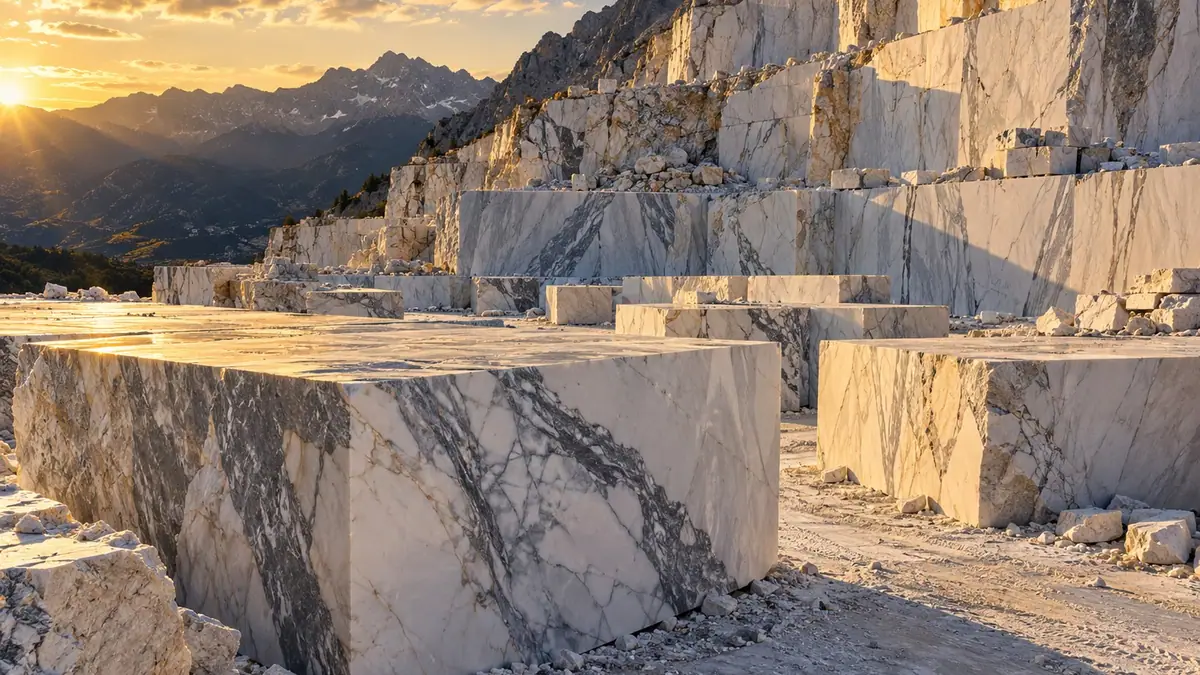
Turkish marble in 2019: China buys fewer blocks, other markets grow
Turkey's natural stone exports fell to $1.86bn in 2019 as block marble sales to China dropped about 10%. What it meant for buyers of slabs and tiles.
A year below target
Turkey is one of the world's largest suppliers of marble and travertine, and China has long been its biggest customer for raw blocks. In 2019 that relationship cooled. According to the annual report of the Istanbul Mineral Exporters' Association (IMIB), Turkey's natural stone exports fell 4.27% in volume and 2.29% in value to 7.14 million tonnes and $1.86 billion. IMIB chairman Aydın Dinçer wrote that the sector had not reached the performance it expected, pointing to the US-China trade war, a slowdown in construction and lower unit prices across world trade.
Blocks hit hardest
The weak spot was raw block. Exports of marble and travertine in block or roughly trimmed form fell 11.13% in volume and 8.48% in value, to 4.48 million tonnes and $864.9 million. Even so, block marble remained Turkey's single largest mining export item. China took $693.0 million of those blocks, down 10.28% on 2018. India followed at $88.8 million, up 1.15%, and Italy at $16.9 million, up 35.34%.
Across all natural stone, shipments to China fell from 3.95 million tonnes in 2018 to 3.38 million tonnes in 2019, a drop of 14.39% in volume and 10.19% in value to $694.8 million. China still accounted for more than a third of Turkey's stone exports by value.
Why China bought less
China's marble import market had been shrinking for some time. A report by Turkey's commercial counsellor in Beijing notes that China imported around 6.2 million tonnes of marble under HS 251512 in 2018, and that Turkish exporters shipped 3,244,785 tonnes to China that year. The same report found that Italian marble landed in China at a per-tonne price 45% higher than Turkish marble in 2019, which shows where Turkish stone sits: high volume, mid-range price, closely tied to Chinese construction. The head of the Turkish marble producers' association TÜMMER later said China used to buy about 14 million tonnes of blocks a year, including hard stone, and had cut that to around 10 million tonnes.
Where the stone went instead
Processed products held up better. Processed stone made up about 52.9% of Turkey's natural stone exports in 2019, against 47.1% for blocks. Processed marble brought in $709.71 million on 1.78 million tonnes. Processed travertine grew 9.75% in volume and 4.86% in value to 593,947 tonnes and $222.29 million, with the US the main buyer and France up 34.57%.
Market by market, Saudi Arabia rose 18.54% to $125.5 million, France 11.39% to $61.9 million and Israel 8.56% to $65.6 million. The US, the largest market for processed Turkish stone, slipped 4.52% to $285.9 million, and the UAE fell 26.64% to $39.7 million.
What this meant for a stone buyer
- Expect more block availability. When China buys fewer blocks, quarries and Turkish processors have more material to cut at home. That can widen the choice of slab and tile for buyers outside China.
- Compare direct and indirect routes. Turkey supplies a large share of China's marble imports, so a slab cut in China may well be Turkish stone. Buying processed stone directly from Turkey can shorten the chain and make quarry origin easier to verify.
- Fix the selection, not just the price. Ask for quarry name, block number, finish, thickness tolerance and photos of the actual lot. Price per square metre means little without the grade.
- Match payment to inspection. For first orders, CAD or an L/C with an inspection certificate before shipment protects against a lot that differs from the sample.
- Read the market signals. In 2019 weaker Chinese demand showed up first in block volumes. Ask suppliers whether that softness is reflected in their slab and tile offers.
The takeaway
2019 showed that Turkish stone depends heavily on one buyer for raw blocks, while processed products and markets such as the Gulf and Europe were growing. For importers of marble and travertine, that mix creates room to buy finished stone closer to the quarry.
